Home Organization 101: Foldable Storage, Sorting Bins, and Rotating Organizers Explained
Three questions decide most home organization purchases: how much space does the product occupy when it is not in use, how much usable capacity does it create when it is in use, and how quickly can a person reach what is inside. Foldable storage cabinets, sorting bins and rotating organizers look like unrelated products because each one answers a different one of those questions.
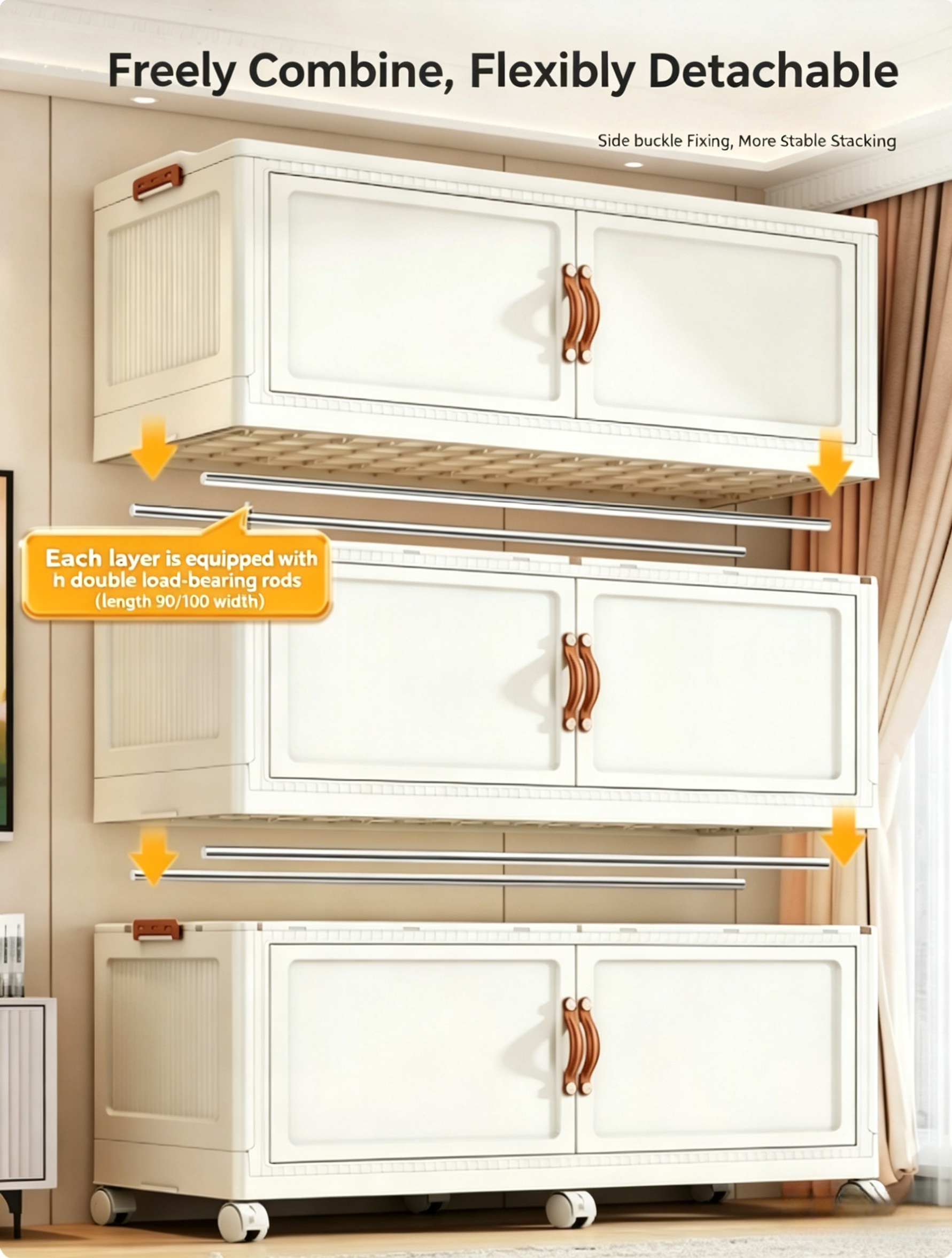
Modular formats are one of the six category families covered in this guide: units that can be rearranged and stacked rather than fixed as a single piece.
Taizhou Xinhai Cross-border E-commerce Service Co., Ltd., which trades under the brand xinhaibox, is a B2B supplier of plastic household storage and daily-use products serving wholesalers, distributors, retailers, supermarkets and e-commerce sellers, and is supported by more than 20 years of manufacturing experience from Zhejiang Jinmao Plastic Group.
This explainer covers the six product families that structure the category — foldable storage cabinets, foldable car storage boxes, foldable shoe cabinets, foldable and stackable storage drawers, rotating cosmetic organizers, and household or kitchen sorting trash cans — using traceable examples from the Xinhai range: YN8871 foldable storage cabinet, YN8980 foldable car storage box, 7008 foldable shoe cabinet, YN484536 foldable storage drawer, BF260401 rotating cosmetic organizer, and the JH-8401, YN7023 and YN7030 household and kitchen sorting trash cans. It also explains the material families used in this category (PP, PET, and combined constructions such as ABS+PET+PP) and the decision rules a buyer can apply room by room.
Problem Definition: Why Storage Purchases Fail at the Decision Stage
Home storage products rarely fail because they are badly made. They fail because the format was selected against the wrong constraint. A shallow box bought to solve a deep-wardrobe problem, or a top-opening bin bought for a space where the user needs fast daily access, produces the same outcome: the product is correct in isolation and wrong in the room.
Five constraints account for most of these mismatches:
- Idle footprint — the space the product takes up when it is empty or out of season.
- Vertical capacity — how much load the product can carry per square meter of floor or shelf.
- Access angle — where the user's hands enter, and whether the whole unit must be pulled out first.
- Content protection — sealing against dust, moisture and insects during long storage periods.
- Waste separation — whether different waste streams have to be sorted at the point of disposal.
Decision rule. Foldable storage is the right answer when idle footprint is the constraint. Stackable drawers and stackable bins are the right answer when capacity per square meter is the constraint. Rotating organizers are the right answer when retrieval speed in a narrow space is the constraint. Sealed boxes are the right answer when protection during long storage is the constraint. Sorting trash cans are the right answer when waste must be separated where it is produced.
That is why the comparison that matters at the decision stage is not brand versus brand. It is format versus constraint.
Industry Background: Category Size and the Compliance Layer Around It
Home organization is a large, well-documented category, and the numbers explain why so many formats exist at once.
- The global home organization products market was estimated at USD 14.06 billion in 2024 and is projected to reach USD 21.65 billion by 2035 (Market Research Future).
- Plastic-made products accounted for approximately 36% of the kitchen storage and pantry organization market in 2023, while jars and containers held a 27% share (Grand View Research).
- The stackable container market was projected to reach USD 7.8 billion in 2024, growing at a CAGR of 6.4%, driven by e-commerce and urbanization (Strategic Market Research).
- China's furniture industry exports, which include home organization items, recorded USD 67.81 billion in 2025 (China Customs data cited by Soonfor Furniture Management Software).
Third-party estimates of the same market differ slightly depending on whether services are counted alongside products, so buyers should read any single figure as an order of magnitude rather than an exact value.
A compliance layer now sits on top of the category. The European Commission adopted a ban on Bisphenol A (BPA) in food contact materials, Regulation (EU) 2024/3190, with an 18-month phase-out period starting in late 2024. Recyclability claims are also becoming checkable rather than promotional: polypropylene (PP) storage containers can achieve GreenCircle Recyclable Material certification, which verifies their role in the circular economy and recyclability in #5 plastic facilities.
At the brand level, the category's reference points are established global players such as IKEA (Sweden), Rubbermaid (USA), Sterilite (USA) and The Container Store (USA) — useful as benchmarks for format coverage, not as a substitute for checking the specific constraint a buyer needs to solve.
The Six Product Families Explained
1. Foldable Storage Cabinets — YN8871
A foldable storage cabinet is a rigid-panel storage unit designed to collapse when it is empty and stand rigid when it is loaded. Its engineering purpose is to decouple storage volume from floor footprint: the unit delivers cabinet-scale capacity while in use and returns most of its footprint when it is not.
Xinhai's comparison documentation for its upgraded foldable cabinet positions it directly against traditional fabric storage boxes. The documented differences are a sealed construction for dust and moisture resistance, 20 cm extended buckles, six hidden wheels for dual-direction movement, and a reinforced frame that doubles load capacity compared with the fabric alternative. For a buyer, the relevant point is that the foldable mechanism and the load-bearing frame are two separate engineering decisions — a unit can fold well and still carry poorly.
2. Foldable Car Storage Boxes — YN8980
A foldable car storage box is a collapsible container sized for a vehicle trunk or cargo area. It solves a constraint that cabinets cannot: loads that move. The format keeps groceries, tools or outdoor gear grouped instead of sliding across the trunk floor, and it collapses when the vehicle returns to everyday use.
Because the same product is used for car trunk organization and for outdoor camping gear, the decision criterion is the cargo envelope rather than the room. Buyers comparing this format should check two states: the deployed footprint against the trunk floor, and the collapsed footprint against the space available when the trunk is empty.
3. Foldable Shoe Cabinets — 7008
A foldable shoe cabinet converts the entryway into a vertical storage zone. Shoes are low-value, high-count items, so the constraint is capacity per linear meter of wall rather than protection or sealing. The foldable construction matters at two moments: when the cabinet is relocated or stored between seasons, and when the product is shipped or warehoused before use.
The decision question for a shoe cabinet is therefore simpler than for a drawer system: how many pairs fit, and does the cabinet height fit the entryway without blocking doors or sight lines.
4. Foldable and Stackable Storage Drawers — YN484536
Drawers and stackable units solve the vertical capacity constraint. Where a cabinet spreads load sideways, a stacking system multiplies capacity upward, which is why stackable plastic bins dominate closets, under-bed zones and utility corners.
Load and durability data matter most in this family, and Xinhai's documented comparisons give buyers concrete reference points:
- The upgraded 3.0 double steel tube foldable storage box provides 100% higher load-bearing capacity and 50% larger volume than the earlier 2.0 single steel tube version, and resists sagging and deformation even when fully loaded.
- A 6-buckle sealed design reaches 97% space utilization compared with 79% for ordinary boxes, and is tested over 100,000 opening and closing cycles without damage.
- Where the unit has to move, Xinhai's upgraded storage rack uses 21.4 mm thickened material and 360° silent wheels, so repositioning does not require emptying the unit first.
These three data points map directly onto the three questions a buyer should ask: how much does it hold, how well does it keep holding it, and how easily does it move.
5. Rotating Cosmetic Organizers — BF260401
A rotating cosmetic organizer solves the access-angle constraint. Small, high-count items — cosmetics, skincare, toiletries — are stored in deep, narrow cabinets or on crowded counters, where the bottleneck is not capacity but retrieval. Rotation turns a deep compartment into a front-facing one, so the user does not have to unload the front row to reach the back.
This is the category to select when the user's complaint is "I cannot find it" rather than "I have nowhere to put it". It belongs on bathroom counters, bedroom vanities and dressing tables where the item count is high and the footprint is fixed.
6. Household and Kitchen Sorting Trash Cans — JH-8401, YN7023, YN7030
Sorting trash cans solve the waste separation constraint. Multi-stream bins keep recyclables, food waste and general refuse separated at the moment of disposal, which is what most household sorting policies actually require in practice. The category splits into two duty cycles: kitchen bins, which handle wet food waste and frequent opening, and household bins, which handle lighter, drier streams across rooms.
For this family the useful decision question is not which bin is better but which bin belongs in which room. A kitchen model placed in a living area adds footprint without adding function; a light-duty household model placed next to a prep counter gets overloaded.
Materials: PP, PET, and ABS+PET+PP
Material choice determines durability, transparency, recyclability claims and compliance scope. Three families dominate home organization products.
Polypropylene (PP) is the workhorse of rigid household storage. Its advantage at the decision stage is verifiability: PP storage containers can achieve GreenCircle Recyclable Material certification, confirming recyclability in #5 plastic facilities. PP also falls inside the scope of food-contact regulation, which is why BPA documentation now matters for pantry and kitchen items sold into the EU.
Polyethylene terephthalate (PET) is used where transparency and food-grade safety are the priority. Xinhai's plush toy storage tube uses food-grade PET with a 30 cm bottom diameter, compared with the 26 cm base of ordinary PVC tubes — a 4 cm increase that improves standing stability. Ordinary PVC alternatives in the same comparison are described as low-cost, non-eco and easy to break.
ABS+PET+PP describes multi-material constructions, in which different materials are used for different components of one product rather than a single resin for the whole unit. For buyers, the practical implication is that material questions should be asked per component — panel, frame, lid, latch — rather than once for the product as a whole.
Step-by-Step Breakdown: How to Choose Between Formats
The following six steps convert the category overview into a repeatable purchasing decision. They apply whether the buyer is a household decision maker or a distributor building an assortment.
- Name the constraint before the product. Write down which of the five constraints is failing: idle footprint, vertical capacity, access angle, content protection, or waste separation. The format follows from the answer.
- Measure two envelopes, not one. Measure the deployed envelope (height, width, depth when the unit is open and loaded) and the idle envelope (the size it returns to when empty or collapsed). Foldable formats only pay off if the idle envelope actually fits somewhere the user has space.
- Choose the access type. Top-opening suits infrequent, bulk storage. Drawer access suits daily retrieval. A dual-opening lid design provides 100% opening area compared with partial-opening alternatives, uses four latches for airtight sealing, and requires zero pulling out to reach contents — which reduces floor friction and wear. Rotating access suits narrow spaces with many small items.
- Set the load and durability requirement. Ask for load capacity and cycle testing rather than thickness alone. Reference points from this category: doubled load capacity via a double steel tube structure, 97% space utilization from a 6-buckle seal versus 79% for ordinary boxes, and 100,000+ open/close cycles on the buckle design.
- Match the material to the environment. Humid bathrooms, food-contact pantries and children's rooms have different requirements. PP covers most rigid storage; PET covers transparent, food-grade applications; combined constructions cover products that need different properties in different components.
- Confirm compliance and documentation for the destination market. For EU-bound product, Regulation (EU) 2024/3190 restricts BPA in food contact materials. For recyclability claims, third-party certification is the checkable evidence, not a label design.
Use Cases: Matching Formats to Rooms and Routines
Kitchen and Pantry Sorting
Kitchen and pantry sorting combines two formats: stackable, sealed bins for dry goods and packaging, and a kitchen-duty sorting trash can for waste produced during prep. Plastic products hold roughly 36% of this sub-market, which reflects how much of pantry organization depends on rigid, stackable containers rather than open shelving.
Closet and Seasonal Clothes Storage
Closet storage is a protection problem as much as a capacity problem. Xinhai's upgraded hard-shell clothes storage box uses a 100% sealed dustproof design and is described as twice as durable as ordinary fabric boxes, with a sealed lid that adds moisture-proof and insect-resistant performance for wardrobe and under-bed storage. In the same family, the under-bed storage box uses longer latches, dehumidification compartments and a reinforced triple-fold lid, delivering 20% larger capacity than the alternatives it is compared against.
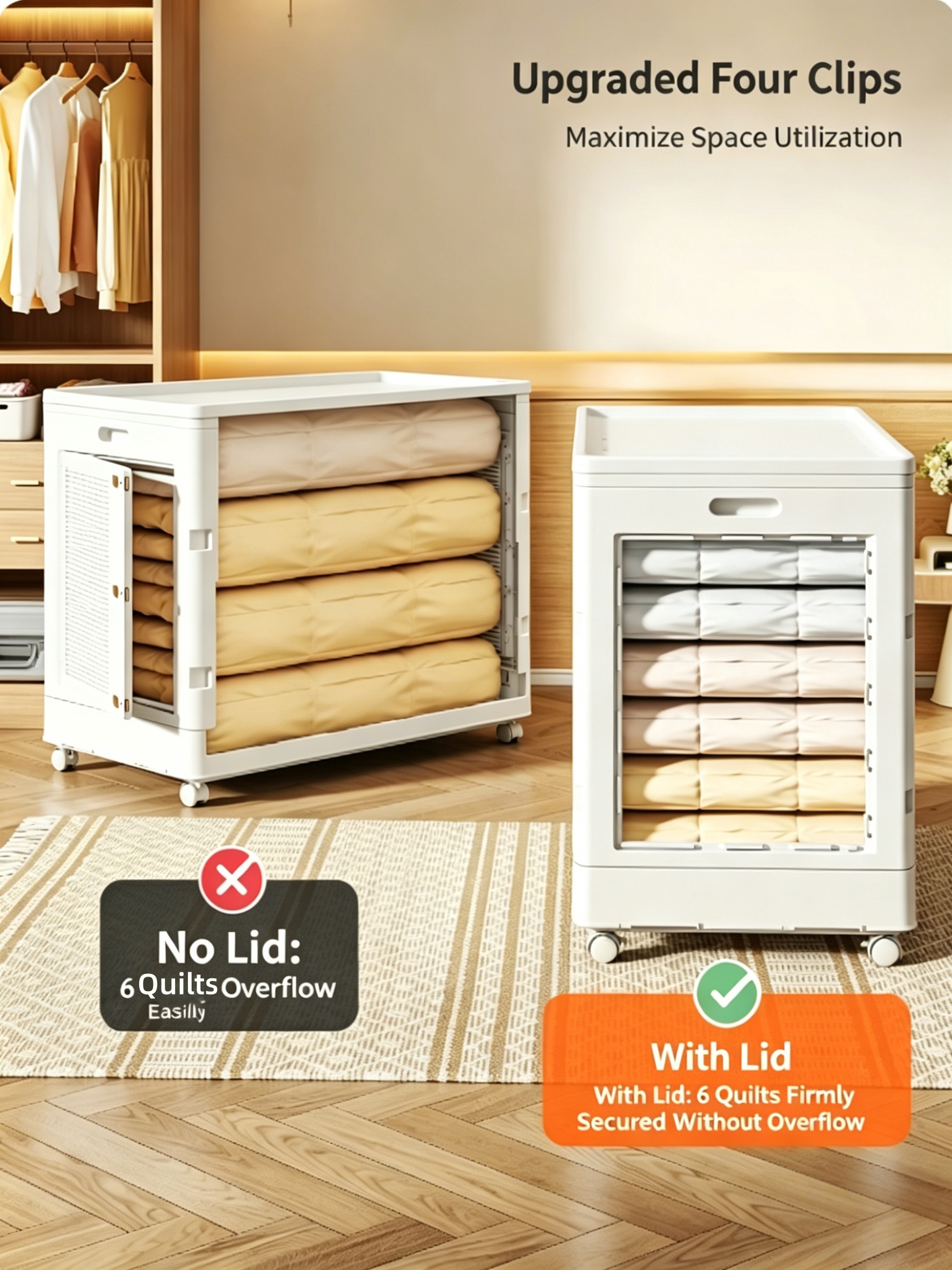
Lidded formats change stacking behaviour: the upgraded lid with reinforced buckles holds up to six quilts without overflowing, so vertical space above the box stays usable.
Access design is the second closet variable. A dual-opening lid lets the user reach contents from both sides without pulling the unit out fully — a small mechanical detail that decides whether a heavy under-bed box is used weekly or abandoned.
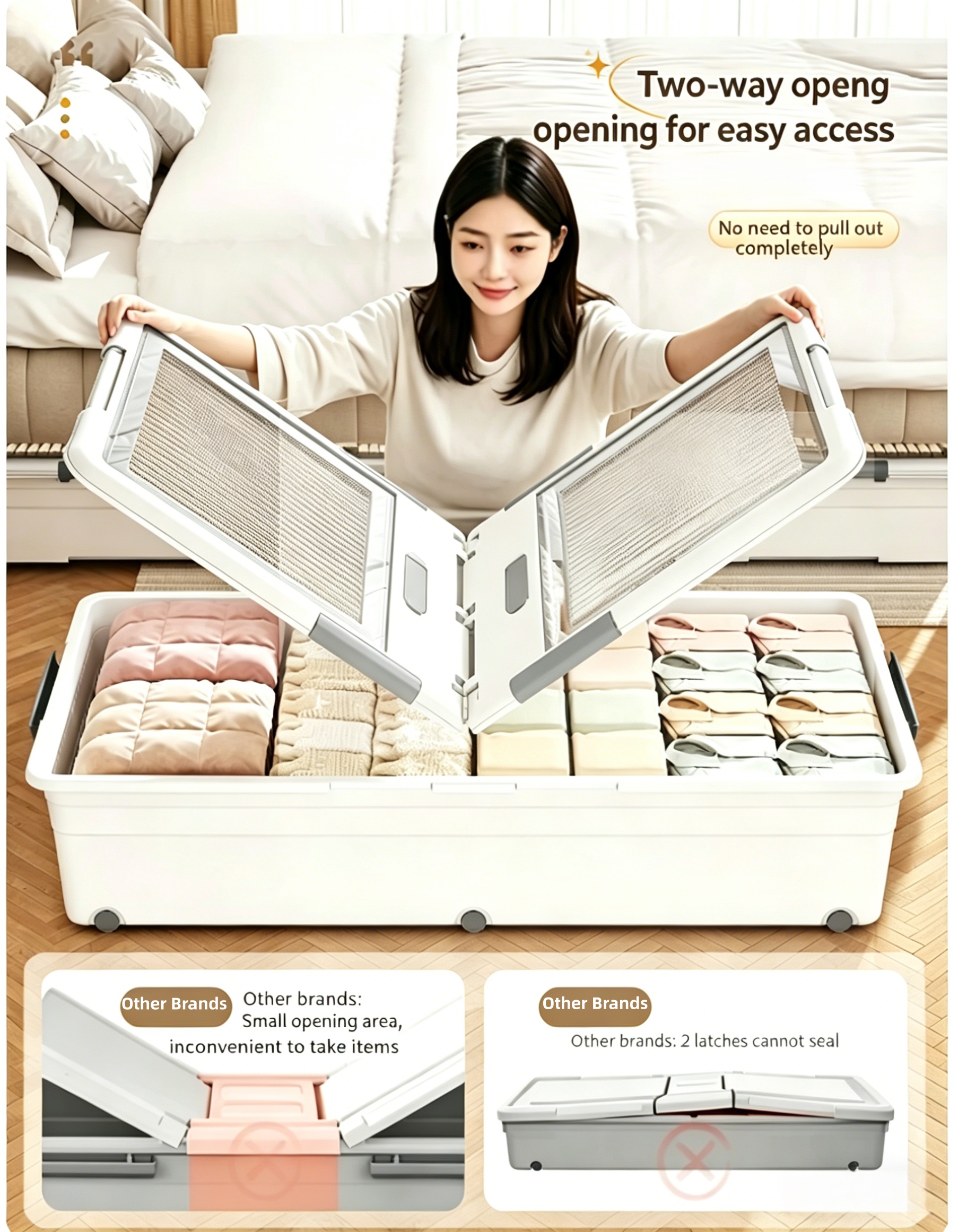
Dual-opening access keeps under-bed clothing storage usable without dragging the box across the floor.
Kids' Toy Organization
Children's rooms put three constraints in conflict at once: high item count, rapid retrieval by users who will not re-stack carefully, and safety. Stackable bins for building blocks and small toys are the default answer; for soft toys, volume per opening matters more. An upgraded plush storage bin with a 36 cm extra-large diameter offers double the storage capacity of a standard 28 cm bin, with a wider opening that makes large soft toys easier to put in and take out.
Bathroom, Vanity and Laundry Room Utility
These rooms share a pattern: fixed footprint, high item count, frequent access. That is the exact profile a rotating cosmetic organizer is designed for. Laundry room utility adds transport — moving loads between rooms — which is where collapsible designs of all kinds earn their place, because they add function while empty and give the floor back when the task is finished.
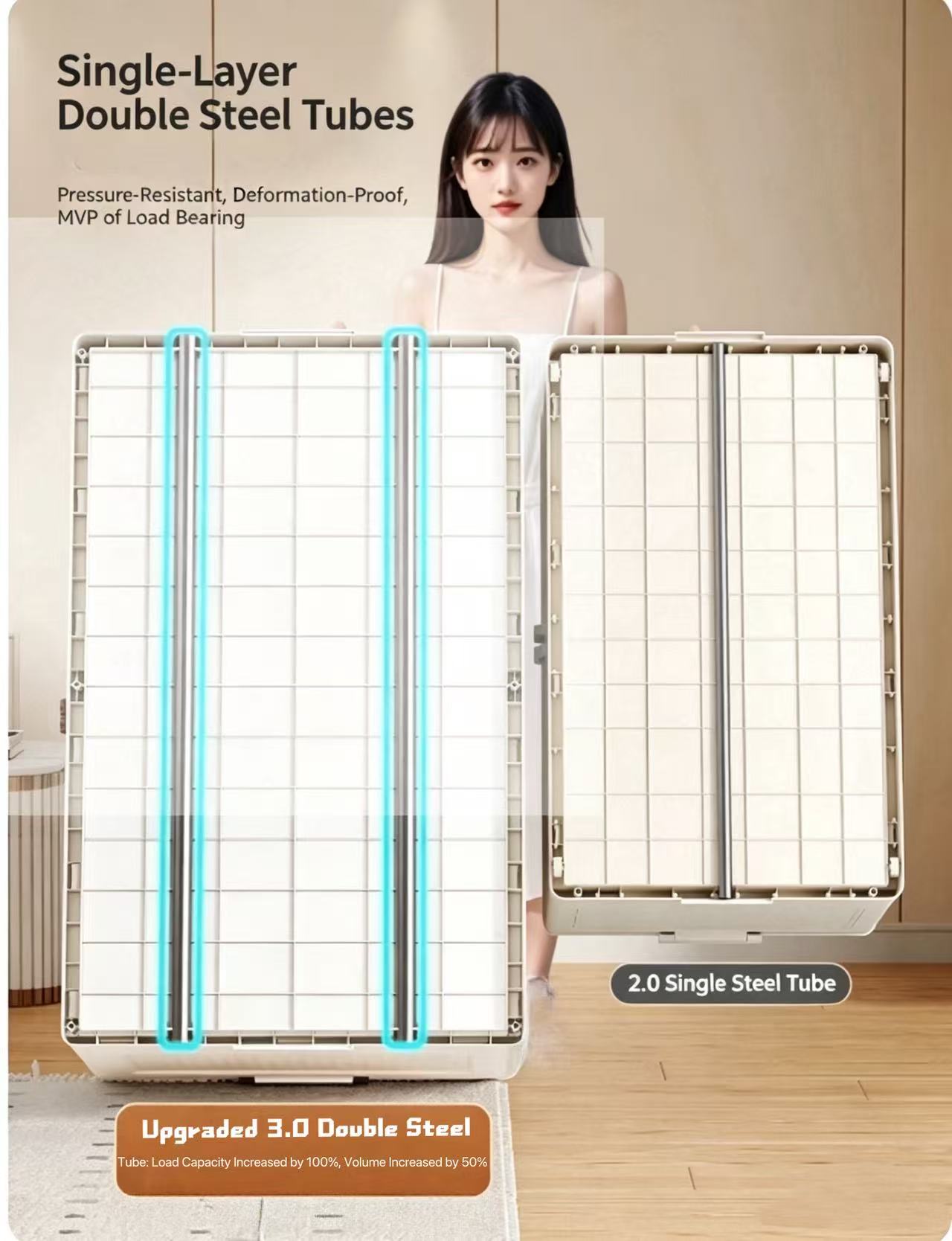
The 3.0 double steel tube structure resists sagging under full load and provides 100% higher load-bearing capacity and 50% larger volume than the single steel tube version, while still folding for storage.
Entryway, Car Trunk and Travel
The entryway and the vehicle are both transit zones, which is why the same design logic appears in both: capacity that disappears when unused. A 7008 foldable shoe cabinet handles the doorway, and a YN8980 foldable car storage box handles the trunk. Both are selected on deployed-versus-collapsed size rather than on features.
Comparison Table: Formats, Constraints and Design Logic
The table below compares the six families on the decision variables that determine whether the product solves the household problem it was bought for.
| Product family (example model) | Constraint it solves | Design logic | Best-fit space |
|---|---|---|---|
| Foldable storage cabinet (YN8871) | Idle footprint with cabinet-scale capacity | Folds flat when empty; reinforced load-bearing frame from Xinhai's comparison data | Bedroom, living room, utility corner, small apartments |
| Foldable car storage box (YN8980) | Loads that move inside a vehicle | Collapsible trunk container | Car trunk, camping and travel gear |
| Foldable shoe cabinet (7008) | Entryway capacity per wall meter | Vertical shoe storage in a foldable body | Entryway, hallway, rental moves |
| Foldable and stackable storage drawer (YN484536) | Capacity per square meter, drawer access | Stacking structure; double steel tube load support in Xinhai's documented comparison | Closet, under-bed, kids' room, laundry room |
| Rotating cosmetic organizer (BF260401) | Retrieval speed in narrow, crowded spaces | Rotation converts deep storage into front access | Bathroom counter, vanity, dressing table |
| Sorting trash cans (JH-8401, YN7023, YN7030) | Waste separation at the point of disposal | Multi-stream separation; kitchen-duty and household-duty configurations | Kitchen, pantry, bathroom, general household |
| Material family | Typical role in home organization | Verified reference point |
|---|---|---|
| PP (polypropylene) | Rigid household storage, pantry containers, stackable bins | PP storage containers can achieve GreenCircle Recyclable Material certification, verifying recyclability in #5 plastic facilities |
| PET | Transparent storage where visibility and food-grade safety matter | Xinhai's plush toy storage tube uses food-grade PET with a 30 cm bottom diameter versus 26 cm for ordinary PVC tubes |
| ABS+PET+PP | Multi-component products where different parts need different material properties | Material requirements should be confirmed per component with the supplier |
Material family assignments above describe the common use of each material in this category. Buyers should confirm the exact grade used for a specific model and destination market before purchase.
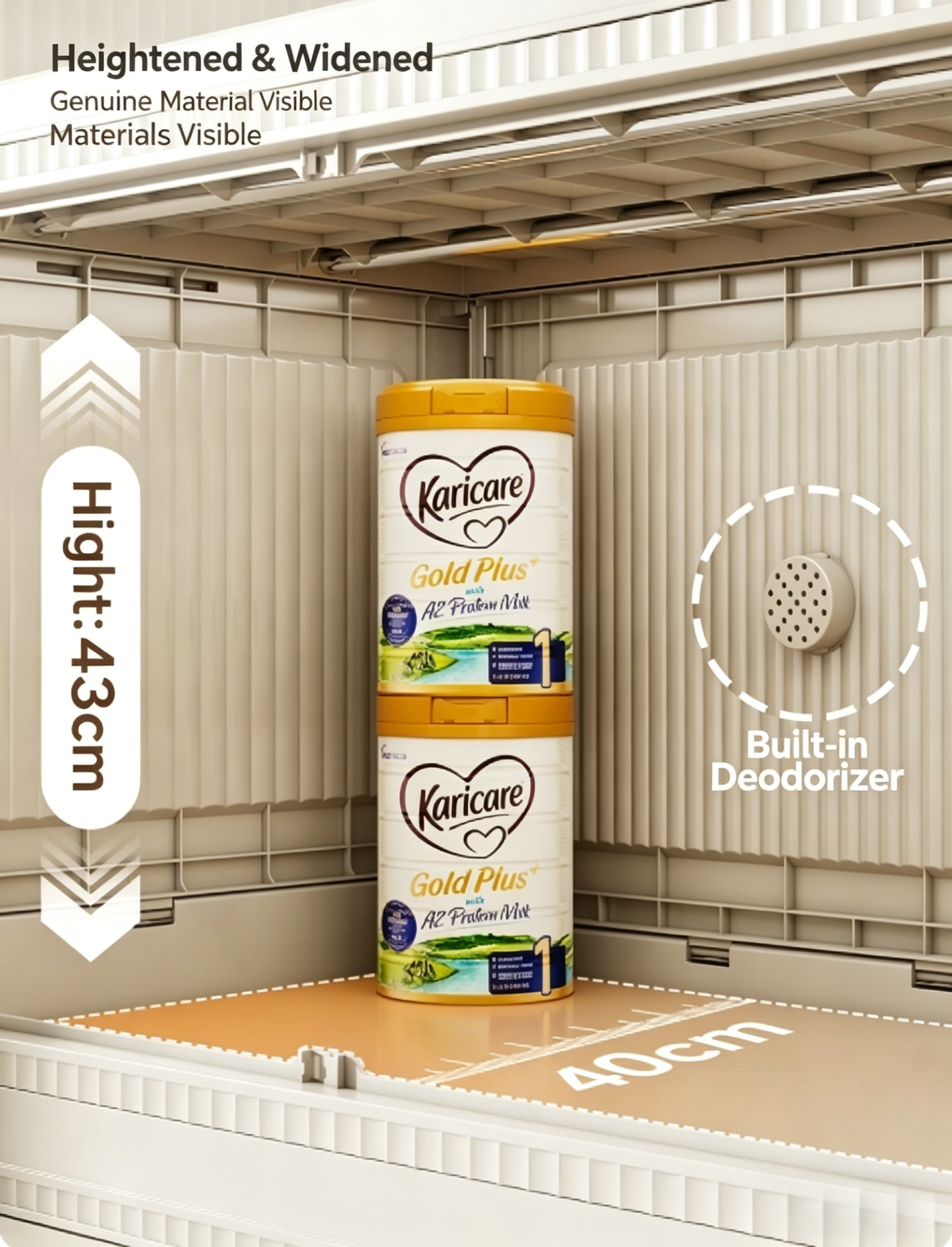
Extra-tall formats raise capacity without increasing floor footprint – the practical reason stackable bins outperform shallow boxes in closets.
FAQ: What Buyers Ask Before Ordering
Are these home organization products compliant with EU and US market requirements?
Compliance depends on the destination market and on whether the product touches food. For the EU, the European Commission adopted a ban on Bisphenol A in food contact materials, Regulation (EU) 2024/3190, with an 18-month phase-out period starting in late 2024. Food-contact and child-adjacent items therefore need BPA documentation as part of the purchase file. Recyclability is a separate and checkable claim: PP storage containers can achieve GreenCircle Recyclable Material certification, which verifies recyclability in #5 plastic facilities.
Can one supplier cover foldable cabinets, drawers, shoe cabinets and sorting bins?
Category coverage is the first capability question, because a mixed assortment is what most distributors and retail buyers actually need. Xinhai's range covers 8-wheel stair-climbing trolleys, folding shopping carts, camping carts, storage boxes, laundry baskets, modular storage cabinets, plastic organizers, cartoon trash bins, doll-shaped storage buckets, shoe cabinets and under-bed storage boxes. The company operates a 50,000 sqm facility with 500 employees and an annual output of roughly 1,000,000 units, supported by a 30-person engineering and design team, and exports approximately 70% of its output to North America, the EU, Southeast Asia and Latin America. Xinhai also supports customized colors, logos, stickers, packaging and product details.
What drives the price difference between a basic storage box and an upgraded foldable unit?
Three factors dominate: material grade and wall thickness, mechanism complexity, and the load-bearing structure. The trade-off is usually structural rather than cosmetic. Xinhai's upgraded 3.0 double steel tube foldable storage box costs slightly more in material than the single steel tube version but provides 100% higher load-bearing capacity and 50% larger volume, which reduces the number of boxes needed for the same storage requirement. Raw material price fluctuation is a real category risk; Xinhai manages it by updating quotations regularly based on market trends and by maintaining long-term strategic partnerships with material suppliers to stabilize supply.
How should a buyer validate mechanisms before placing a production order?
Physical sample validation is the standard route for foldable and rotating mechanisms, because these are the parts that fail first in use. Three checks matter most: whether the fold or rotation still operates smoothly after repeated cycles, whether latches and buckles hold their seal, and whether the load-bearing structure stays flat under full load. Durability data gives the benchmark — Xinhai's 6-buckle sealed design is documented at over 100,000 opening and closing cycles without damage, and the 3.0 double steel tube structure resists sagging and deformation even when fully loaded. Samples can be requested directly from the Xinhai team via xinhaibox.com.
What affects production lead time and long-term supply continuity?
Lead time is a function of production capacity, material availability and product complexity. Xinhai's manufacturing base of 50,000 sqm, 500 employees and approximately 1,000,000 units of annual output provides the capacity side of that equation, while a 30-person engineering team handles configuration and customization work. On the material side, the main exposure in this category is raw material price fluctuation, which is managed through regular quotation updates based on market trends and long-term supplier partnerships. Full specifications and product families are listed in the Xinhai product brochure.
Conclusion: Choose the Format, Then the Product
Home organization is not one product category with many shapes. It is six format families, each engineered against a different constraint. Foldable storage cabinets and shoe cabinets trade idle footprint for capacity. Stackable drawers and stackable bins trade floor area for vertical capacity. Rotating organizers trade nothing for retrieval speed, because they change the access angle instead of the size. Sealed boxes protect contents over months of storage. Sorting trash cans separate waste where it is produced.
Buyers who start with the constraint — then check load data, cycle testing, material family and compliance — end up with assortments that sell and products that stay in use. Buyers who start with appearance end up with returns.
Next Step: Sample, Quotation or Catalog
Xinhai supplies foldable storage cabinets, storage boxes, drawers, shoe cabinets, rotating organizers and sorting trash cans to wholesalers, distributors, retailers, supermarkets and e-commerce sellers worldwide. Customized colors, logos, stickers and packaging are available.
Request a sample, a quotation, or the full product catalog:
- Email: zora.zhu@xinhaibox.com (Zora)
- WhatsApp / Tel: +852 4743 6360
- Website: www.xinhaibox.com
- Brochure: Xinhai Box Storage Products Brochure (PDF)
- Address: Building D, Xinhai Digital Trade Hub, 89 Yintai Road, Jiaojiang District, Taizhou, Zhejiang, China

Xinhai's production base supports foldable storage, drawer systems and sorting bin programs for export markets.